The Frantics
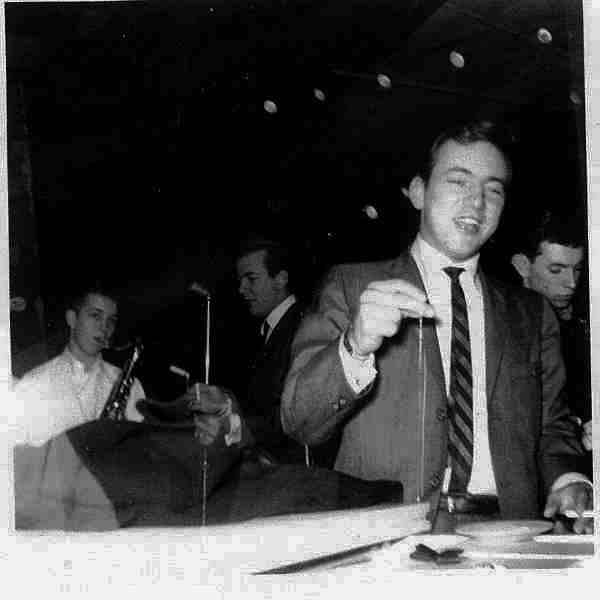
– (1957-63) The group played hundreds of dances throughout the Northwest,
recorded with Bobby Darin (Dream Lover), and backed a number of national
acts at venues in Seattle, Portland and Spokane. The group also played
in nightclubs in California, Oregon and Washington.
The 1957 - 1963 Frantics
were the “classic” Frantics. Other groups splintered off after
the breakup of the group in fall of l963. It was also this
1957-63 group that recorded a number of tunes including three that made
the Billboard charts. The three recordings that made the Billboard
charts were:
Straight Flush (A)
/ Young Blues (B) Dolton ( Joel Goodman on
drums )
Fog Cutter (A) /
Black Sapphire (B) Dolton
Werewolf (A) / Checkerboard
(B) Dolton
In addition to the
above, the Frantics also recorded:
The Whip (A) / Delilah
(B) Dolton
Yankee Doodlin (A)
/ One Minute of Flamenco (B) Dolton
San Antonio Rose
(A) / Trees (B) Dolton
All the above were
recorded in Seattle with the following personnel:
Petersen - Guitar
Schoning - Keyboards
Hosko - Sax
Manolides - Bass
Fulton - Drums
Joel Goodman - Drums (on Straight Flush)
In 1960, while in
California, The Frantics recorded a number of other tunes in Hollywood.
These were never released and I don't know where the masters are located.
These cuts can be heard on the Frantis CD, "The
Complete Frantics on Dolton". (Ron Petersen, October 2003)
In l961, when Manolides
left the group and was replaced by Jeno Landis, two more records were made.
Meet Me in Seattle Twist (A) / Bony Moronie (B) Seafair Bolo Records
Let Our Love Roll On (A) / Oh Yeah! (B) Seafair Bolo Records (Petersen
on vocal)
The original group dissolved
in fall of l963. Thereafter, Chuck Schoning had another group called
The Frantics and so did Petersen. Chuck's group recorded several
more tunes and moved to California. Because Chuck was recording using
the name The Frantics, the Petersen group became Ron Petersen and the Accents.
The title recorded by that group was:
Linda Lou (A) / Sticky (B) Jerdan Records (introduced on the records
by KJR's Pat O'Day)
THE FRANTICS YEARS -
Penultimate formation – 1963 - 1965
My time with the
Frantics began around August 1963. I was the next to the last drummer with
this seminal teen-music band. For better or for worse, the Frantics provided
some sort of organ removal service for me (more on this later). By 1963,
time was moving on and the Frantics were gradually being forgotten for
their contribution to the NW rock and roll hall of fame. One of the seminal
teen rock bands of the late 1950's, the music they now played was no longer
their classic Straight No Chaser and Werewolf, but rather a powerful rhythm
and blues style. In fact they were no longer a teen band, but young dudes
in search of an identity, playing in taverns and clubs. Newly reformed,
these Frantics had awfully impressive musicians in the band and I learned
a lot about music there. My time with the band was unique for me as I met
other musicians who were developing into a group of deeply skilled players.

Bob
Hosko, Jon Keliehor, Joe Johansen and Chuck Schoning at Dave's Fifth Avenue,
Seattle, 1963
In 1963 I was playing
with a jazz trio at a club called The House of Entertainment with a group
led by Overton Berry on piano. Dave
Press played bass, myself on drums. The club ran after hours. Many
musicians came to sit in and play with the band. There were problems finding
a clear path to music. Transitions were in the wind. Jazz guitarist Larry
Coryell was departing a band called The Dynamics, and Jimi Hendrix was
lurking unseen nearby, having problems finding people to play with. In
1963 I crossed over into R & B music.


Bob
Hosko, Jon Keliehor, Chuck Schoning, Jerry Miller
The
Frantics at Dave's 5th Avenue in 1964
One night, three
unusual individuals approached me. They gave me the impression of a slightly
demented version of the Marx Brothers. One was very, very short, one was
very clean-cut with a 1950's crew-cut hairstyle, and the last was tall,
had eyes that looked in two directions simultaneously and wore thick magnifying
eyeglasses. These were the members of the Frantics, who introduced themselves
as “an ex-teen band who had several hit records . . . perhaps I'd heard
their music?” However, the name didn't ring too many bells at the time.
They identified themselves as Charles Schoning, Bob Hosko and Joe Johansen.
The group praised my playing highly, and wanted to talk.
Mentioning the need
to replace a departing drummer (Joel Goodman), I was asked if I might like
to work with them during a forthcoming engagement at Dave's Fifth Avenue
in Seattle. I asked them what kind of music they played, and was told that
it was rock and roll/rhythm and blues. I couldn't imagine what it would
be like, and it didn't sound like something I'd like to do. I told them
that I didn't know how to play that kind of music very well, and turned
them down instantly.
Within a week they
returned to see me again. They were desperate for a drummer. This time
they offered to help me learn the music, suggesting that I could come to
a rehearsal and see what it was like for myself. I could see that they
believed in what they did. Joe Jo mentioned that it wouldn't be too difficult,
and I wouldn't be disappointed. Charles said that I would be playing every
night and would make quite a bit of money. I became interested.
The Frantics had
two sides. They still played some teen pop songs, yet by late 1963 they
were leaving their former teen-persona behind. They rarely played such
tunes as Fogcutter and Werewolf (by request only), made with all the original
members of the band. The personnel and repertoire had changed considerably
and they had become formidable rhythm and blues merchants, worked in Taverns
and nightclubs, primarily in Seattle and Tacoma.
The music required
the drummer to play with strength and simplicity, and I was asked to lay
down the beat, and to provide a consistent bass drum and backbeat pattern,
loud and strong. I balked. My embarrassment lasted briefly. I learned quickly,
practicing possibilities set out by the music we played. I listened hard
to Booker T and the MG's, the Meters, Bobby Blue Bland, James Brown, and
many great rhythm and blues drummers. Before long I was enjoying myself
tremendously.
During the next few
weeks many surprises were in store as I discovered the talents of the band.
NW guitarist Joe Johansen was a legend and a complete inspiration. He communicated
the essential feeling of the music to me. Although he claimed he lacked
skills as a jazz player, at rhythm and blues he was totally brilliant.
His unique approach to support riff-lines was intensely rhythmic. He played
authoritatively and pushed the rhythm hard. Chords from his Fender amp
were chunky, raw and distorted yet his solos were lyrical and soaring.
When Joe left the
band, guitarist Jerry Miller joined. His playing was a little lighter in
style, and he had a mellower, more liquid sound, similar to that of BB
King. He too was an excellent soloist. They both loved Freddie King tunes.
Miller and Johansen were fantastic to play with. Our saxophone player Bob
Hosko
was one of the founding members of the group. He was an inspired and energetic
player, a wonderful person with a nimble wit. The leader of the band was
Charles Schoning on keyboards. Charles had moulded himself principally
as an entertainer, managing to enact the Frantics teen-persona with a great
deal of skill.
The big surprise
came when organist Mike Mandel was hired to play while Charles Schoning
was away at college. On Monday to Thursday nights it was as if Jimmy Smith
and Ray Charles had both come to sit in at the same time. I believe that
Schoning's real musical growth commenced after he saw Mike Mandel in action.
Mike was an inspiration to us all. Schoning already deeply hooked on rhythm
and blues, soon purchased a Hammond B3 organ. He must have broken the piggy
bank on that one. At this time he keenly sensed the need to leave the band's
teen period behind, as it was the fastest way for him to develop.
Although the national
spotlight on the Frantics had dimmed somewhat, the talent was shining bright.
The group were outstanding musicians who commanded a large repertoire of
rhythm and blues classics. As a drummer my technique soared, putting the
icing on the cake. The band attracted a great deal of musical attention
and peer support. The Frantics enjoyed playing music together and with
others, always offering opportunities for other musicians to sit in and
play. Joining us were such Seattle talents as Dave Lewis, Little Bill,
Larry Coryell, Mark Doubleday, Sarge West, Dicky Enfield, Don Stevenson,
Jim Valley, Patti Allen, many others. Nancy Claire came to sing with the
band. She had long-time ties with earlier versions of the band. A number
one singing talent, she sat in with us at Dave’s Fifth Avenue, the Ago-go
Club, and various places. Her presence was compelling and her visits always
welcome. This late version of the group recorded only two tunes for Dolton
Records: San Francisco Swim and Blue Day.
Deciding to expand
their influence outside of Washington State, the Frantics traveled to San
Jose, California in May 1965 to audition for a club. The audition was successful,
and the Frantics moved to San Jose in July 1965. On the way my little Volkswagen
Beetle was introduced to the front end of a large, fast moving truck. I
was admitted to the emergency room of a nearby hospital with a ruptured
spleen. The band were stopped at the California border, and told the news
of my accident. They returned to Seattle to contemplate things, but eventually
went on to San Jose while I recovered. The Frantics survived for another
year. Their new drummer Don Stevenson, along with Jerry Miller and Bob
Mosely found their way back to California, towards the formation of Moby
Grape.
The hippie music
of 1965 saw the Frantics era come to a close. The government were looking
for young men to go to Viet Nam, and the musical times were a-changing.
Jon Keliehor,
December 2007 & April 2009
Transfusion,
Cooker and Chiltins
con Carne were recorded by Chuck Schoning's Frantics in California.
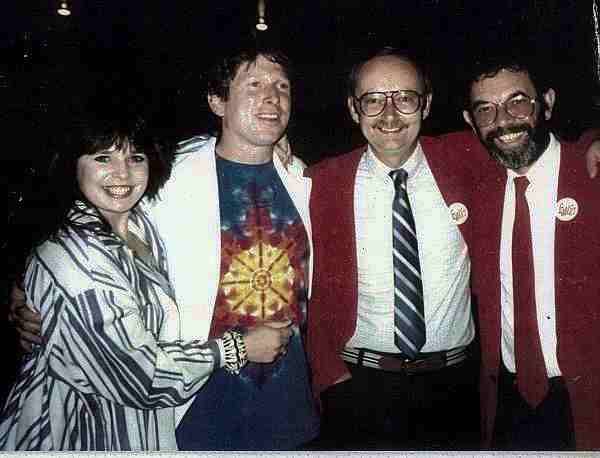
In 1985, The Frantics
had a “Reunion Gig” in Seattle, at the Seattle Center. Several old
Seattle bands played in a concert celebrating the 25th anniversary of the
Seattle World's Fair. There were probably 3,000 people in attendance.
It was a “gas.”